
The format belongs firmly to the crash and mines family, but Tower Rush trades the usual graph-climbing tension for a spatial metaphor. You are not watching a curve rise—you are stacking floors, one at a time, knowing that each addition increases your potential win and your exposure to total loss. It is a test of nerve wrapped in a deceptively simple interface, and it offers enough control to make strategic play worthwhile.
Tower Rush: key facts
| Provider | Galaxsys |
|---|---|
| Type | Crash / Building game |
| RTP | 98.5% |
| Volatility | High |
| Min / max bet | £0.01 / £100 |
| Max win | £10,000 |
| Mobile | Yes |
| Demo | Yes |
Tower Rush delivers transparent, high-RTP crash mechanics with enough control and bonus variety to reward disciplined bankroll management.
What is Tower Rush?
Tower Rush is a crash-style mini-game built around vertical progression. Instead of spinning symbols or watching a multiplier curve, you place floors on a tower, advancing one level at a time. Each successful placement increases your multiplier according to a fixed schedule, and you choose when to collect your accumulated winnings. The catch: the tower can collapse at any moment, erasing your profit if you have not yet cashed out.
Galaxsys, the provider, positions Tower Rush within its crash and building portfolio. The game uses provably fair algorithms, meaning the collapse point is determined before you start climbing—though it reveals itself progressively as you ascend. This is not a slot with scattered RNG outcomes; it is a single-round event where timing and exit discipline define success. The 98.5% RTP sits well above industry norms for crash games, and the £10,000 maximum win offers enough headroom for serious stake multipliers without requiring enormous bets.
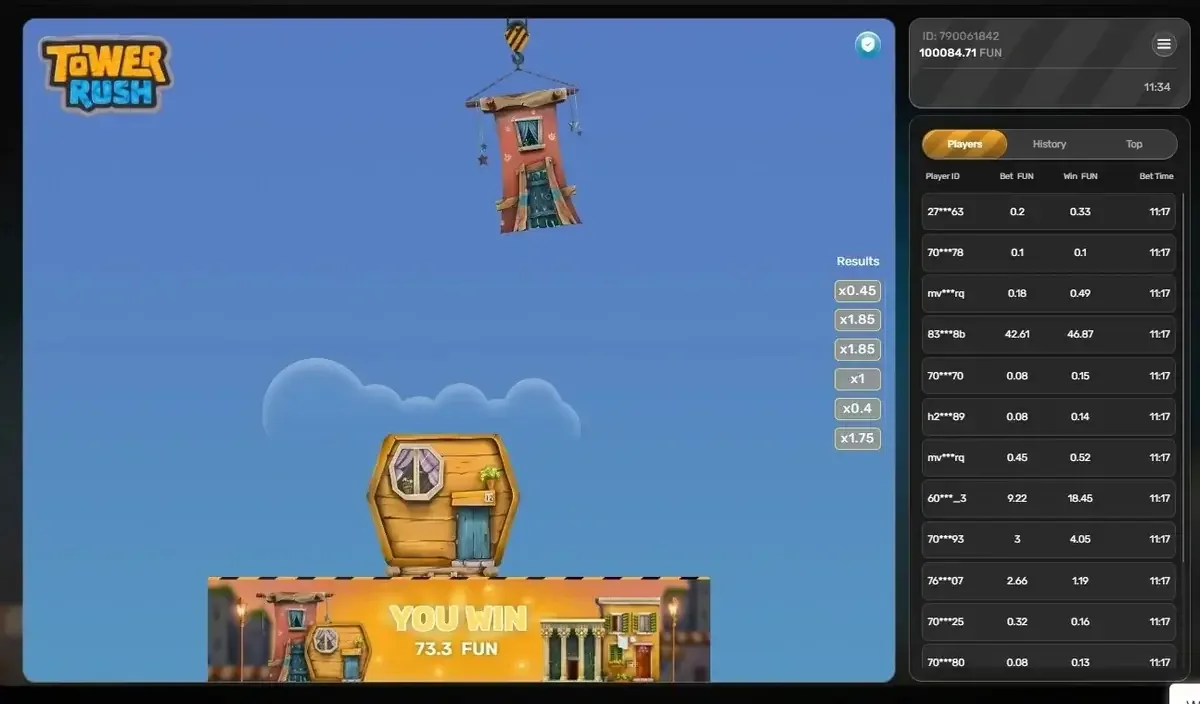
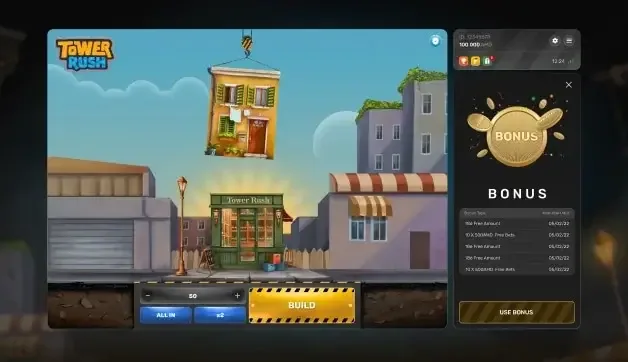
The interface is clean: a central tower display shows your current floor, the active multiplier, recent results from other players, and a prominent cash-out button. You will also find quick-bet controls, auto-cashout settings, and a history panel that tracks recent rounds. The design is functional rather than flashy, keeping the focus on decision-making rather than visual spectacle.
How to play Tower Rush?
1: Set your stake and optional auto-cashout
Choose a bet amount between £0.01 and £100 using the stake selector. If you prefer automated exits, configure an auto-cashout multiplier—this will collect your winnings the moment your tower reaches that threshold. Auto-cashout removes emotion from the equation, executing your pre-planned strategy without hesitation. Manual players can ignore this setting and rely on split-second judgment during the climb.
2: Place floors and watch the multiplier rise
Press the bet button to begin your ascent. Each successful floor placement increases your multiplier and updates your potential payout in real time. The tower structure shows your progress visually, with floors stacking upward as you advance. You will occasionally encounter bonus floors—Frozen Floor locks your current winnings, Temple Floor offers enhanced odds, and Triple Build lets you place three floors at once. These bonuses appear randomly and add strategic wrinkles to your climb.
3: Cash out before the tower collapses
At any point after placing your first floor, you can hit the cash-out button to transfer your accumulated winnings to your balance. Waiting longer increases the multiplier but also raises the probability of a collapse. If the tower fails before you cash out, you lose your entire stake for that round. The tension peaks in the upper floors, where multipliers spike but the margin for error narrows. Your task is to balance greed against preservation, exiting before the structure gives way.
How much can you win?
Tower Rush caps maximum wins at £10,000, achieved by reaching the highest multipliers with a substantial stake. The game features 36 floors, with multipliers increasing as you climb. Early floors offer modest returns—think x1.1 to x2—whilst upper tiers can deliver exponential jumps. The absolute peak multiplier, according to the operator, reaches x1,000 if you survive the entire tower without cashing out or collapsing.
Realistically, most players will exit well before the summit. The collapse probability increases with each floor, and the risk-reward calculus shifts dramatically as you approach the upper levels. A conservative player might cash out at x5 or x10, banking small but consistent profits. An aggressive player might push for x50 or beyond, accepting higher risk for the chance at a significant payout. The £100 maximum bet means a x100 multiplier on a full stake yields £10,000—the game's ceiling.
- Minimum win: determined by your stake multiplied by the first-floor multiplier, typically around x1.1.
- Mid-range targets: cashing out between x5 and x20 balances profit and exposure, suitable for bankroll preservation.
- High-risk pursuit: climbing past x50 offers exponential returns but demands tolerance for frequent total losses.
- Maximum ceiling: x1,000 multiplier at £10 stake equals the £10,000 cap; higher bets are capped at that figure.
Strategies and good habits
Set fixed exit points and respect them
The biggest mistake in crash games is chasing one more floor after you have mentally committed to cashing out. Decide your target multiplier before you bet—x5, x10, x20—and use auto-cashout to enforce that discipline. Over many rounds, consistent exits at modest multipliers will outperform sporadic high-risk chases that end in collapse. Track your results over 50 or 100 rounds to see which exit strategy preserves capital most effectively.
Adjust stake size to your bankroll depth
Tower Rush permits bets from £0.01 to £100, a 10,000-fold range. If you are testing the game or learning its rhythm, start at the lower end and scale up only after you have established a reliable exit pattern. A £1 bet allows 100 attempts with a £100 bankroll, enough to weather variance. A £10 bet gives you ten chances—sufficient for experienced players with proven strategies, but punishing for beginners still calibrating their risk tolerance.
Use bonus floors tactically, not emotionally
Frozen Floor, Temple Floor, and Triple Build appear randomly, offering short-term advantages. Frozen Floor locks your current win, letting you climb higher without risking accumulated profit—a useful buffer when you are near your exit target. Temple Floor increases odds temporarily, making it a good moment to push one or two floors further. Triple Build places three floors at once, compressing risk into a single decision. Treat these bonuses as tactical modifiers, not invitations to abandon your exit plan.
Review session analytics for pattern recognition
Tower Rush displays recent rounds and player behaviour in real time. Whilst past outcomes do not influence future results—the provably fair algorithm ensures independence—the data can reveal your own tendencies. Are you cashing out too early relative to your stated targets? Are you holding too long after bonus floors appear? Use the history panel to audit your decisions, not to predict collapse points.
Free demo or real money?
Tower Rush offers a free demo mode accessible without registration or deposit. The demo uses virtual currency labelled 'Fun', giving you unlimited attempts to test strategies, calibrate exit points, and familiarise yourself with bonus floor mechanics. Everything functions identically to real-money play except the financial outcome, making it a zero-risk environment for learning the game's rhythm.
We recommend spending at least 30 demo rounds testing different approaches: conservative exits at x5, moderate targets at x15, and aggressive pushes past x30. Track which strategy aligns with your risk tolerance and observe how often the tower collapses at various floor ranges. Once you have established a repeatable pattern, transition to real money at the lowest stake that matches your bankroll. Remember that the 98.5% RTP is a long-run average—short-term variance can deviate significantly, and no strategy eliminates the house edge. Play within your means, set loss limits, and treat any session as entertainment rather than income generation. If gambling stops being enjoyable, organisations such as GamCare offer confidential support.
Our opinion
Tower Rush executes its concept with clarity and restraint. The 98.5% RTP is genuinely competitive, sitting above most crash games and well ahead of traditional slots. The betting range accommodates cautious experimentation and serious stake deployment, whilst the £10,000 cap ensures meaningful wins without requiring reckless bets. The bonus floors add tactical variety without cluttering the core mechanic, and the auto-cashout feature supports disciplined play.
The game's weakness is its transparency: there is no illusion of complexity here, no hidden feature to unlock or secondary bonus round to chase. You climb, you cash out, or you lose. That simplicity is liberating for players who value control and clarity, but it may feel thin to those who prefer layered bonus structures or narrative progression. The provably fair algorithm guarantees mathematical integrity, yet 'provably fair' does not mean 'player advantage'—the house edge remains, and over time the maths favour the operator. Tower Rush is honest about what it offers: a high-RTP crash game with transparent mechanics and enough room for strategic decision-making to matter. If that appeals, it delivers on every count.
👍 Pros
- 98.5% RTP among the highest in the crash-game category
- £0.01 to £100 betting range suits all bankroll sizes
- Auto-cashout enforces disciplined exit strategies
- Bonus floors add tactical depth without complicating core gameplay
- Free demo mode for unlimited risk-free practice
👎 Cons
- No progressive features or secondary bonus layers
- High volatility demands robust bankroll management
- Upper-floor multipliers remain largely theoretical for risk-averse players
Frequently asked questions
What is the maximum win in Tower Rush?
The maximum win is capped at £10,000, achieved by reaching high multipliers with substantial stakes. The theoretical peak multiplier is x1,000, though most players exit far earlier to avoid collapse.
Can I play Tower Rush for free?
Yes. Tower Rush offers a free demo mode using virtual currency, accessible without registration. The demo replicates all real-money features, allowing unlimited practice rounds.
How does auto-cashout work?
Auto-cashout lets you set a target multiplier before you bet. When your tower reaches that multiplier, the game collects your winnings automatically, removing the need for manual timing and enforcing pre-planned exit discipline.
What are bonus floors?
Bonus floors appear randomly during your climb. Frozen Floor locks your current winnings, Temple Floor offers enhanced odds, and Triple Build places three floors at once. Each bonus adds a tactical wrinkle to your ascent strategy.
Is Tower Rush provably fair?
Yes. The game uses provably fair algorithms, meaning the collapse point is determined before your climb begins. However, 'provably fair' guarantees mathematical transparency, not player advantage—the house edge remains constant at 1.5% over the long run.